
What Are the Sunday Scaries? 3 Causes and How to Ease Them
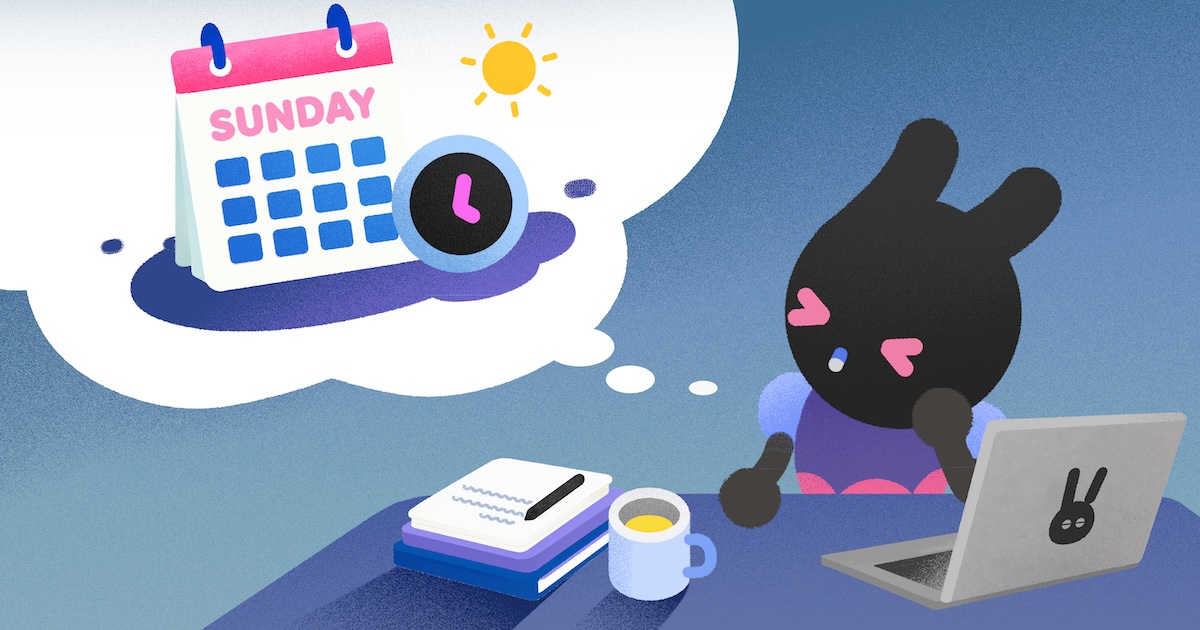
You're home on the couch. The weekend isn't over, but by Sunday afternoon your mood quietly starts to sink—even the plans you were looking forward to feel flat. As the afternoon light dims, a low unease sets in, and Monday inches closer by the hour. This feeling arrives even earlier than the Monday blues. It's the Sunday scaries.
What Are the Sunday Scaries?
The Sunday scaries are feelings of anxiety, low mood, irritability, or restlessness that show up on Sunday afternoon or evening, usually centered on the workweek ahead.
You might feel unable to relax even when nothing is actually wrong. People also call it Sunday anxiety, pre-work dread, or the post-vacation slump.
It's easy to assume you just hate your job or can't handle pressure. But the Sunday scaries are common across jobs and cultures—in a 2018 LinkedIn survey, more than 80% of people said they'd experienced them.
And the feeling isn't random. Three psychological mechanisms are at work.
Why Do the Sunday Scaries Happen?
The Sunday scaries usually come from three overlapping forces: unfinished work, uncertainty about the week ahead, and a shrinking sense of control.
1. Unfinished tasks keep running in the background
Friday often ends with loose ends: an unanswered email, a half-finished project. These open loops don't disappear when the weekend starts—they keep running in the background, quietly draining mental energy.
The Zeigarnik effect describes how we remember unfinished tasks more vividly than finished ones. A 2011 study by Masicampo and Baumeister added a key detail: the loop quiets down once your brain has a concrete plan for what comes next. That's why Sunday anxiety can be so stubborn—the task isn't just unfinished, it has no clear next step, and your brain won't let go of the unknown.
2. Uncertainty turns into anticipatory anxiety
A lot of Sunday dread is about things that haven't happened yet: next week's meetings, a possible conflict, an outcome you can't predict. It's all imagined, but your brain still treats the uncertainty as a threat.
Not knowing what will happen can feel more stressful than knowing something bad is coming.
In their 2013 review, Grupe and Nitschke describe uncertainty as a central driver of anxiety: when an outcome is unpredictable, the brain stays braced for possible threats. The situation may not be real yet, but your nervous system responds as if it needs to get ready.
3. The weekend's sense of control is about to end
For many people, weekdays come with little autonomy—you show up at a set time, handle other people's priorities, and fit your life around work. The weekend is the one stretch that's actually yours.
Weekends feel good largely because you get to be the one deciding how your own time is spent.
In a 2010 study, Ryan, Bernstein, and Brown found that people reported more autonomy, connection, and competence on weekends than on weekdays, along with better moods, more energy, and fewer physical complaints. Sunday evening feels heavy because that freedom is about to narrow again.
How Can You Ease the Sunday Scaries?
You can ease the Sunday scaries by closing unfinished loops, coming back to the present, and making small choices that restore a sense of control.
1. Close the loops with a shutdown ritual
You don't have to finish everything before the weekend. You just need to give your brain a clear stopping point.
Before you leave on Friday, try a simple closing ritual: clear your desk, turn off work notifications, empty your inbox, put the laptop away. Small as they are, these actions tell your nervous system that work is done for now.
Then take a few minutes to write down the most important things for next week. Once your unfinished tasks live somewhere outside your head, your brain has less reason to keep rehearsing them—and it's easier to actually rest.
2. Use your senses to come back to the present
If the anxiety is about the future, the antidote is the present. Sensory awareness can interrupt the brain's habit of constantly predicting what might go wrong.
The moment you notice yourself spiraling into tomorrow, pause and come back to the room. Look at what's around you, listen for the sounds nearby, feel the temperature on your skin, notice a smell in the air or a taste in your mouth.
It sounds almost too simple, but that's the point. When your attention returns to what you can sense, your nervous system gets a different message: right now, it's safe to relax.
3. Make small choices to take back control
If the dread comes from losing autonomy, rebuild it in small ways. You don't need a big life change—just a few decisions that are already yours to make.
Pick what you want for dinner, where to take a walk, which movie to watch tonight. Each small choice reminds your brain that work doesn't run every part of your life.
It also helps to plan one thing on Sunday you genuinely look forward to. When the day has meaning of its own, it stops being just the eve of Monday.
Can Writing Help With the Sunday Scaries?
Yes—simple writing can ease Sunday anxiety by giving your circling thoughts a place to land and helping you decide what comes next.
You don't need a new routine or any special tools. Open your phone or grab a pen and write down whatever's already looping in your head. The three sets of prompts below line up with the three needs behind the Sunday scaries: closure, presence, and control.
1. Notice what you finished
Remind yourself the week held more than just unfinished work.
- What did I finish this week?
- Which moments are worth remembering?
- How would I sum up this week in one sentence?
2. Come back to the life happening now
Shift your attention from what might happen tomorrow to what's already here today.
- What in my life feels worth appreciating right now?
- What good thing am I experiencing today?
- What do I already have, right now?
3. Decide how you want next week to go
A small intention can turn an uncertain week into something with a clear next step.
- How do I want to feel and live next week?
- What's the one thing I most want to do?
- What do I want to make time for?
When Sunday afternoons keep turning into anxious loops, a few honest sentences can help you feel more in charge of the week ahead.
MoodMons is an AI journaling app that hatches a mood monster from what you write, with psychology-informed daily prompts for moments like these. Writing becomes more than capturing what happened—it's a small way to take care of yourself, at your own pace.
References
- LinkedIn. Your Guide to Winning @Work: Decoding the Sunday Scaries (2018).
- Grupe, D. W., & Nitschke, J. B. Uncertainty and Anticipation in Anxiety: An Integrated Neurobiological and Psychological Perspective (2013).
- Masicampo, E. J., & Baumeister, R. F. Consider It Done! Plan Making Can Eliminate the Cognitive Effects of Unfulfilled Goals (2011).
- Ryan, R. M., Bernstein, J. H., & Brown, K. W. Weekends, Work, and Well-Being: Psychological Need Satisfactions and Day of the Week Effects on Mood, Vitality, and Physical Symptoms (2010).